
On the shared sustainability crisis facing Blender creators and the platforms that support them.
Last week I stood in front of a room full of Blender artists, developers, and creators at BCON Austin and told them something uncomfortable: the ecosystem we've all built together is breaking.
BCON was something special. It is such a privilege to have face time with such a range of people that’re all gathered around a shared interest. Hundreds of people from all over the world, representing every corner of the Blender community. Film and game studios, add-on developers, educators, hardware startups, hobbyists, automotive design, medical visualization, and more. People who've staked their passion and livelihoods on Blender. These were people with real skin in the game.
And the add-on creators in that room, the ones building and selling the tools that power so much of this community, are being quietly crushed by the model they're selling under. So are we.
This post is an extrapolation of my talk at BCON, and the why behind an upcoming change to Superhive called Support Periods. Shortly after this I'll share another post laying out the explicit what and how. Update, that post is here.
You can watch the recording of my BCON Austin talk below:
Growth requires friction
Growth rarely happens in comfort zones. Without friction, entropy tends to win and the things we build slowly wither.
To illustrate this I want to share two moments in Blender's history that I had a direct hand in. Both were met with resistance. Both led to significant growth for Blender and the community. And both offer a useful lens for what we're facing today.
But first, three fundamentals that apply to every project.
Three legs of the stool
Every project, no matter the size, rests on three fundamentals that must stay in balance:
Time. No project succeeds without the hours to do the work.
Motivation. No project succeeds without the drive to keep doing it.
Money. No project succeeds without the means to fund it.
This applies to Blender, to add-ons, to conferences, and it absolutely applies to marketplaces like Superhive. Let one leg weaken and the whole thing wobbles. Let it fail and the project fails with it.
Commercial add-ons in 2014
Prior to 2014, the normal state of Blender add-ons was one of constant decay. Unless bundled directly with Blender, the vast majority were freely released with no promise or ability to maintain the code. Without fail, most lost out to entropy and stopped working.
To help solve this we launched Superhive, Blender Market at the time, giving creators a real reason to improve and maintain their tools. In exchange for their time, they could earn money from artists who valued what they'd built.
The pushback was immense. "This is the beginning of the end for Blender." Commercial add-ons would destroy the community's purity, turning everything into a nickel-and-dime transaction. As it turns out, the community grew stronger. People could feed their families by doing the work they love.
Today, 7,500 creators are building a livelihood around Blender through Superhive, producing over 60,000 products. Nearly $50 million has been paid out. That's what happens when people have a sustainable reason to keep building.
Right click select in 2018
Another friction point worth mentioning: in 2018 the Blender UI team changed the default selection from right click to left click in version 2.8. It was a decision I was heavily involved in, and the community pushback was fierce. Many called it the enshittification of Blender.
I'll be honest, it was uncomfortable. We knew the right click paradigm created a steep learning curve for new artists and was driving most of them away within their first moments of opening Blender. But watching the community react so strongly gave us pause. Within a year of the 2.8 release, though, we saw the payoff. New artists stayed. Established artists switched from other software. Blender’s user base began to grow dramatically faster than before. The barrier had been lowered without sacrificing the speed and flexibility that makes Blender so powerful.
Change that feels threatening often isn't. That lesson applies here too.
Today’s friction
The friction we're experiencing today stems from a single assumption baked into the Blender creator economy: that every product comes with lifetime updates and support.
I wrote about this in depth back in February. The short version is that this assumption is crushing creators and Superhive alike. Every sale adds a new customer to support. Revenue doesn't grow to match. The gap widens every year.
This graph tells the story clearly. The left bar is the cumulative customer base creators are supporting. The right bar is product sales, which maps directly to revenue.
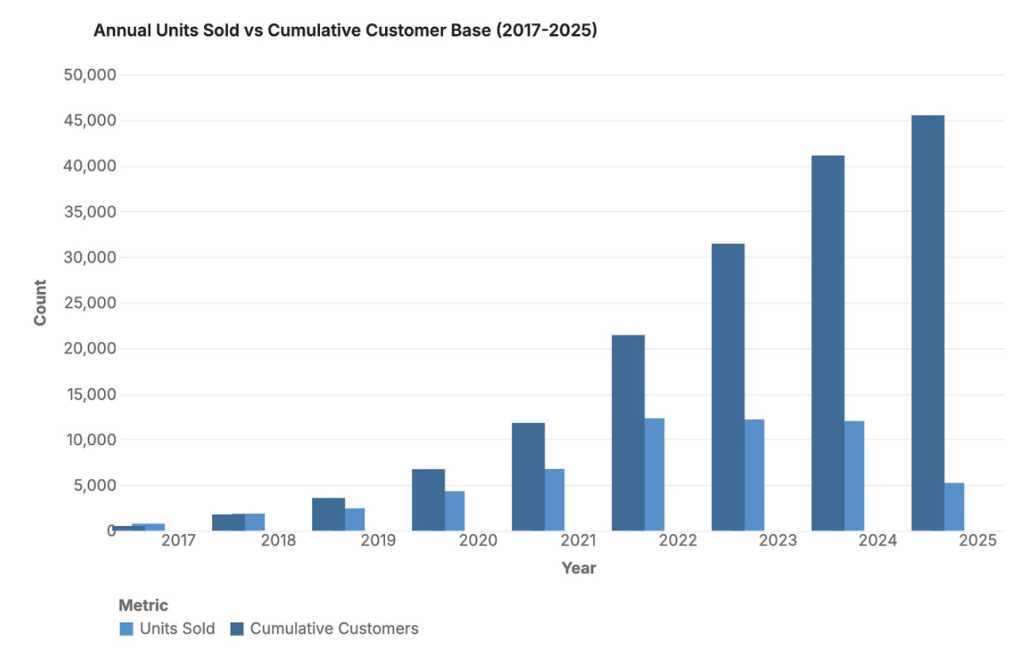
There is no scenario where this trend leads to a healthy ecosystem, it’s a net negative for everyone.
Two diverging paths
At this moment we find ourselves at a fork in the road. We can continue as we have, ignoring the signals and selling products through an assumed model of lifetime updates. Or we can embrace the friction and course correct toward something sustainable.
Status quo
Choosing to do nothing means accepting the trajectory we're already on. The customer base grows. Revenue doesn't keep pace. Creators work harder every year for less return, spending more time on support and updates for existing customers than on building new things. Motivation erodes. Eventually the time and money legs of the stool give out.
We've already seen this pattern play out across virtually every top seller on Superhive regardless of category, product type, or audience size. This isn't a temporary dip. It's a structural problem. And left unaddressed, it ends with creators burning out or walking away, and a marketplace with fewer and fewer quality products to offer.
Sustainable future
The alternative is a model where the value exchange is clear and honest. Creators define a support period for their products. Customers know exactly what they're getting. Updates and support are tied to that period, giving creators a predictable reason to keep investing in their work and a fair path to additional revenue when they do.
This isn't a radical idea. In both open source and proprietary software, developers have been trying to tackle this problem for years with a variety of different solutions, each with trade-offs. The friction here isn't the change itself. It's unlearning an assumption that was never written down but somehow became the expectation.
Our solution
The model has to change. Not because we want to impose something on the community, but because the current path leads somewhere no one wants to go.
We've spent the better part of two years working on this, developing a solution we believe is fair to creators, honest with customers, and sustainable for the long term. We're calling it Support Periods.
This post is the why. The next one will be the what and how, and it's probably not what you've heard. We'll be sharing that shortly.
We're in this together. That's exactly why we're doing something about it.