
The last ten years have seen incredible growth in Blender’s user base. Alongside it, an entire ecosystem of creators has blossomed. From add-on developers to modelers, asset library authors to geometry node wizards, many more people now support themselves, fully or partially, through Blender than when I started. It’s a remarkable time to be part of this community.
Blender founder Ton Roosendaal has long acknowledged and encouraged the commercial activity surrounding Blender, even though the software itself is free and open-source (GPL). In a recent interview, he reaffirmed that the economic layer of Blender belongs to the community, to us, to you, to build.
I started learning Blender in 2003 and began working professionally a few years later. At that time, commercial opportunities were mostly limited to freelance production work. Few studios hired Blender artists, and the broader ecosystem simply didn’t exist.
Arguably, the modern creator ecosystem didn’t begin to take shape until we launched Blender Market, now Superhive, in 2014.
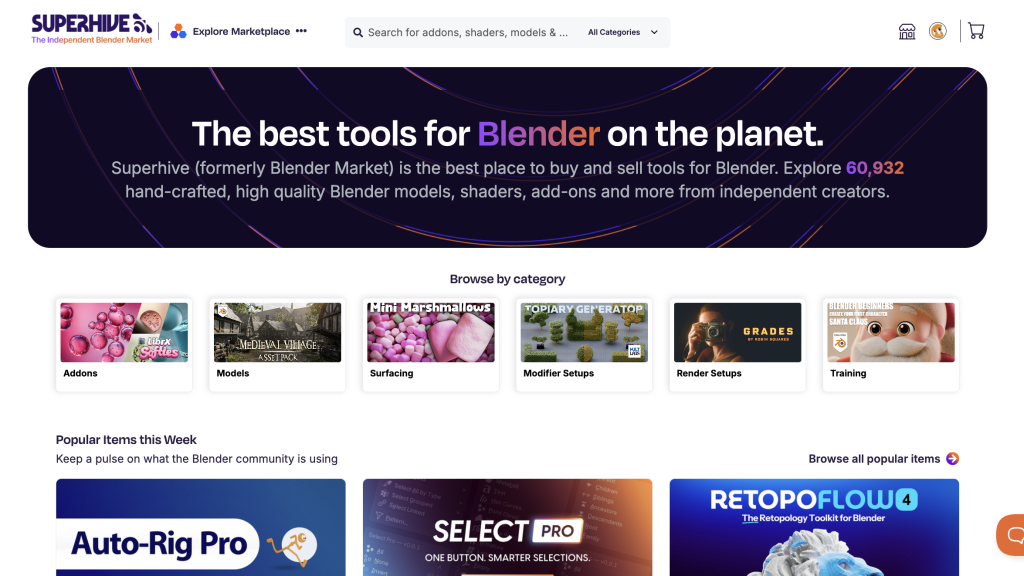
We don’t claim credit for starting the Blender creator economy. But the launch of a Blender-focused marketplace undeniably reduced friction for motivated Blender creators. For many, access to an audience was the missing piece. Even today, that conduit remains an essential value-add for creators launching and sustaining Blender-based businesses.
The first few years saw consistent, compelling growth. Superhive metrics doubled year over year, peaking in 2022. Eight consecutive years of doubling is not trivial.
Today, thousands of creators support themselves in part or entirely through Blender product sales.
But the equation has changed.
In our many conversations with creators (e.g., Creator 4 Creator interviews) and in the metrics we observe on the marketplace, it’s becoming clear that many are facing a slow-moving crisis. It’s subtle at first, easy to miss. But each year the symptoms become more visible.
Blender Creators are being squeezed between declining sales and an ever-increasing number of customers who expect ongoing updates and support
With good intentions, creators support more people every month while rarely earning additional revenue from them. Many are working harder than ever for less income.
We conducted several in-depth case studies and reviewed performance data across virtually all top sellers in recent years. There is remarkably little deviation. This is not a small group of popular creators reacting to a temporary downturn. The pattern is consistent across categories, product types, and audience sizes.
To illustrate the pattern, we reviewed performance graphs from a handful of Blender creators (anonymized below).
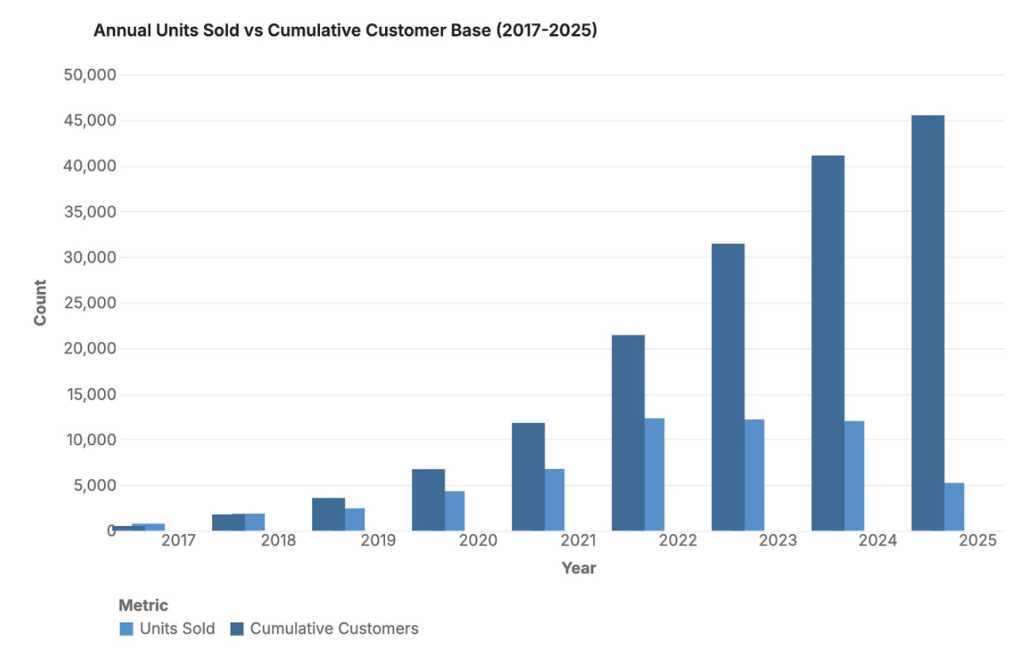
The first chart above shows cumulative market performance: total units sold (perceived income) alongside cumulative users supported.
The notable thing in all of these graphs is that, in every instance, the number of users keeps growing while the number of sales is either flat or declining. That means each new sale carries the weight of supporting an ever-expanding base of prior users. Over time, revenue per supported user declines. The work does not.
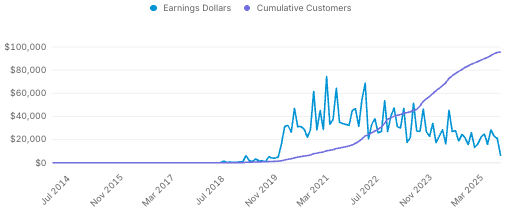
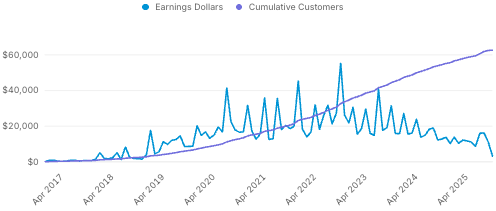
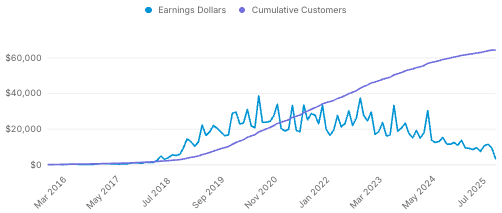
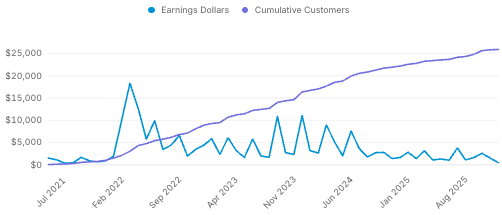
The trend is concerning; the featured creator charts above are staking their entire livelihoods on product sales that are becoming increasingly precarious. And they are far from alone in our research and conversations with creators.
Left unchecked, many creators could eventually step away. Creative tools, assets, and training will drift toward entropy, as they did before this young Blender economy formed around these community contributions.
There are many factors behind this sales pattern. But the core issue is structural: there is a default expectation of lifetime updates and support
The promise feels/is honorable. Supporting customers indefinitely feels right. It’s no surprise that many creators try to uphold it. But living, evolving software cannot be sustainably funded through one-time purchases paired with indefinite obligations. This is not a Blender problem. It is not a marketplace problem. It is not a technology problem. It is a business model problem.
It is also worth clarifying that Superhive has never required or promised lifetime updates on products sold through the platform. Over time, however, that expectation has become the cultural default. And defaults shape behavior.
Ironically, one of the original motivations for creating Superhive was to enable long-term support for creators, so the Blender community could benefit, grow, and continue building remarkable things with software we all care deeply about.
Most of us remember when exciting new tools emerged in the community in the early days, gained traction quickly, and then faded away. Not because they lacked value, but because sustaining them required ongoing work without sustainable compensation, especially as Blender evolved at a rapid pace.
Consider a simple thought experiment: name a tangible, real-world product where a company is expected to improve it, fix it, and support it forever after a single purchase. There are very few. And those that do resemble this model tend to be static products that change little over time.
Software is the opposite of static. It evolves rapidly. Blender, in particular, evolves at a pace that is difficult for any individual to match.
Blender creators, especially add-on developers, need a more responsible and evolved default model for selling and supporting their work. No creator should be pushed to a breaking point simply because they succeeded at the hardest part of building anything: reaching an audience willing to pay.
This is the start of a broader conversation.
We’re raising these concerns openly and actively engaging with creators and customers to better understand the pressures they’re facing, and to explore more sustainable models going forward. We intend to share more in the coming weeks and months.
If you’re a creator or customer and want to share your experience, please send us an email to [email protected].
Thanks for reading, and happy Blending.
Jonathan